Joachim Trier isn’t 100 percent comfortable with the fact that his Oscar contender, “Sentimental Value,” is being labeled a melodrama. But then again, he was never comfortable with the idea of ever making a film that could be interpreted as one. On the Filmmaker Toolkit podcast, the self-described “counterculture punk” said his decision to tackle the emotional family story was his most difficult.
“I’m out on a limb with this one,” said Trier. “I’ve done this the best I can, [to] go to very gentle, tender places of love and connection and disconnection, to try to get in the intimacy of these relationships for real, and I’ve been really anxious throughout the whole process, asking ’Is it too much?’”

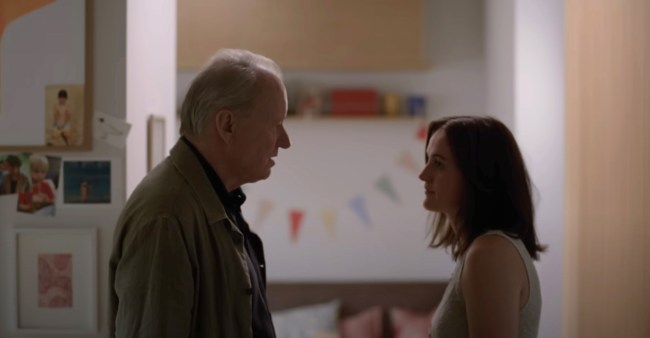
The celebrated Norwegian filmmaker’s sixth film digs into an area most people reserve for therapy: The unspoken space in parent-child relationships, and those wounds that don’t get discussed, but that get handed down and carried by the next generation. The idea that the unreconciled trauma of the father, celebrated film director Gustav Borg (Stellan Skarsgård), is something carried by his estranged daughters, in particular the actress Nora (Renate Reinsve), presented Trier with a screenwriting challenge.
His previous films had tackled multi-character narratives that switched between perspectives, but “Sentimental Value” would be what Trier described as his first “polyphonic story.”
“This [multi-character narrative] more than anything I’ve done, I’m trying to create this one emotional arc in the story,” said Trier. “It’s a super complicated balancing act, and thematically, we realized that we had a film when we had the ending.”
The ending of “Sentimental Value” is a moment of true movie magic, an extended silent scene, in which the source of that trauma is not discussed, but we share in the emotional undercurrent of a profound moment of understanding between father and daughter. While on the podcast, Trier dug into the ending, the narrative structure of how he built toward that moment, and the power of the human face on the big screen.
Gustav’s Movie ‘Homesick’
In “Sentimental Value” we see the one word Swedish title of Gustav’s screenplay, which Trier said translates to “longing for home;” homesick being the less poetic one-word translation in English.
Trier said he introduced Gustav to the audience through Nora’s point of view, as a “failed father” coming back to the home he abandoned for their mother’s funeral. Nora sees Gustav’s attempt to make his first film in 15 years, with her starring, as being the product of the same narcissistic self-interest that made him a bad father. What she doesn’t see is that Gustav’s “longing for home” is his attempt to get at the wounds associated with growing up in the same house Nora did, where his mother was tortured and captured during the war, and eventually committed suicide.
According to Trier, what Nora doesn’t come to realize until the end is the making the film is actually Gustav “humbling” himself as a parent.
“What I was interested in turning it around and realizing that this film he’s made is a love letter,” said Trier. “Because he doesn’t have a language for it in his social life to say [to his] daughter, ‘That I see you and I think you carry the same loneliness that I do. And it’s a mystery to me. Let’s explore this together and make a movie, because it’s the best I can do.’”
The reason the discovery of the ending was such a critical breakthrough for Trier and co-writer Eskil Vogt was it showed they could merge “the theme of the fictional and the real in creative people’s lives.” Explained Trier, “We realized that we could tie Gustav’s expression of a deep unspoken loneliness into his pondering upon his mother’s suicide and his worry of not being able to communicate with his daughter — and the daughter’s experience of strangely carrying the weight of three generations — in an unspoken, wounded way, all into that film that he’s making.”
Ozu and the Younger Sister Role
That’s not to say Gustav has this stated goal when he sets out to make the film, said Trier, “As an artist, I imagine Gustav, the purpose of creating something isn’t always obvious.” The story of two artists, who both avoid their trauma and its connection to their art, presented another screenwriting challenge: How to structure a film that organically leads to the breakthrough on the movie set.
“So structurally, how do we set all that up? How do we balance the different point of views? How do we draw a cinematic picture of that unspoken space between them?,” said Trier. “Because these are people that are quite articulate and they can talk, but they’re also avoiding as hell about the essential thing.”
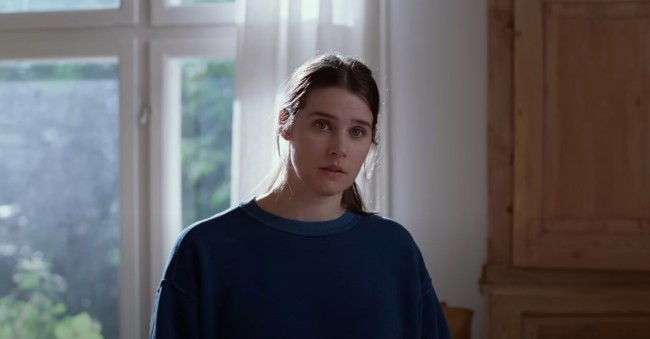
Trier would find the answer by studying other filmmakers whose films delved into similar unspoken aspects of family dynamics. In particular, it was the archetype of the younger sister or daughter character in Yasujirō Ozu’s films that led him to the character of Agnes (Inga Ibsdotter Lilleaas) as the solution. Explained Trier, “That the younger sister, the gaze — and staying with the look of silence at the table– of the one that’s listening and observing and for the audience to slowly realize that she sees more than the others, but how will she convey that, that sense of love?”
Agnes is the inverse of her sister and father, the one who chose not to pursue a career as an artist (despite starring in one of her father’s most celebrated films as a child) and instead have a family of her own. And It’s from this perspective that she is able to see what haunts them both. The quiet character’s loving struggle to help them connect the dots is the narrative engine Trier would need.
“I’m trying to make more of a polyphonic story and to hopefully surprise the audience a bit,” said Trier. “And the heart of the story really being carried by the loving younger sister, Inga Lilleaas, where at the beginning, she’s more an observer, but then actually she’s a very important piece in how to resolve at least the baby steps of reconciliation that we’re offering here.”
Silence and the Face
While discussing the ending on the podcast, Trier talked about how throughout his career he’s tried to build toward these extended silent moments, especially at the end of his films. His second feature, “Oslo, August 31st” took this to extremes, ending with nearly 30 minutes of no dialogue. Said Trier. “We build towards it so that I hope the audience has a sense of enough [of what’s] at play for interpretation, to really give depth to silence.” The reason Trier is drawn to these types of big silent moments is that they rely on what he believes is the filmmaker’s greatest tool.
“We can talk about mood and light and space, but ultimately, the human face is what I get the biggest kick out of. I love closeups and I cast for closeups,” said Trier. “I really care that the actors can do that thing that we can only do in the movies, which is be aggressively intimate with them, and look at them in a way that we can’t in real life. That’s why I go to the movies. You’re allowed to stare at each other in a perversely intense way that no one sane human being would do with another human being, and really get to know someone’s face and to read them and empathize with them.”
One of the most impressive aspects of the “Sentimental Value” script is that it lays the foundation for the depth of complex emotions Reinsve and Skarsgård explore and convey with just their faces.
“For them to look at each other after that, knowing that they don’t know how to talk at all, but that something that the audience is allowed to interpret themselves – something must have moved forward, something must have happened in that reciprocal long process of gazes at the end,” said Trier.
While editing “Sentimental Value,” Trier received the note from several people that he shorten the ending and cut way back on Reinsve and Skarsgård silent looks. It was something he determined he couldn’t do. There was too much there.
